



After the fall and destruction of Jerusalem in 70 A.D., one group of Jews held out against the Roman armies for three more years. The group occupied the hilltop fortress of Masada.
Masada was originally constructed by King Herod the Great between 37 and 31 B.C. as one of his five luxurious palaces. Masada served as both a luxurious retreat and a fortress, as it was situated atop a hill with steep cliffs on all sides.
The Roman armies surrounded Masada, building barracks and walls to prevent anyone from escaping. They mistakenly assumed that the siege would be short since there was no natural source of water on Masada.
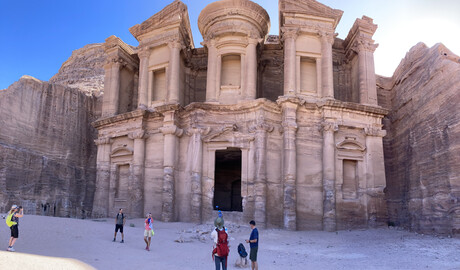
What the Romans didn’t know was that Masada was originally constructed with about 30 cisterns built into the mountain, which utilized the hydro engineering skill of the Nabataeans of Petra. It’s famously told that, at one point during the siege, the commander of the Masada holdouts released all the water from a cistern down the side of the mountain just to prove that they had plenty.
The Nabataeans of Petra were famous for their ability to capture and store water, and they had perfected the cistern-building technique.
Here’s how it worked: First, the engineers would identify a low point in the land where rainwater naturally pooled. Then, when it was dry, they would dig a small cistern in that place. When the rains came, they would make note of which cisterns filled up completely and overflowed. After they used all the water, they would dig it out further. This process would repeat year after year until the cistern was large enough to capture all the runoff rainwater from the surrounding land.
Additionally, the land itself was prepared to receive the rainfall. The soil is a very fine silt. Once this silt gets wet, it dries into a hard clay that water can easily flow off. The land around the cisterns was prepared for the rains in this way. Masada was a masterclass in the use of this technology.
I was privileged to go down into one of the largest cisterns at Masada, which holds nearly 900,000 gallons. The inside is cavernous, measuring approximately 30 feet wide by 100 feet long by 40 feet high. No wonder water wasn’t a problem at Masada.
Beyond the obviously interesting historical details, I believe that Masada, and more specifically the cistern construction process, can metaphorically teach us some important lessons about our own spiritual experience.
The Bible frequently uses the language of seasonality. For instance, God gives the rain in its season (Lev. 26:4; Deut. 11:14; Jer. 5:24), which produces crops in their season. It seems strange to think of rain having a season while writing from the Pacific Northwest on a rainy fall day, but that is the reality for many places around the world.
We live in a world that demands nearly constant productivity. The seasons around us change, but few of us experience any real change in our day-to-day lives with those changes. Is it possible that we’ve bought into the idea that our spiritual lives need to resemble our professional lives — constantly productive and devoid of seasons?
What if our spiritual lives were much more like the seasonality of rainfall and agriculture? Agriculture has times of plowing, sowing, growing, harvesting and replenishing — each in its own season, not constant productivity.
A cistern is similar. It’s filled by the seasonal rains. The water is slowly drawn out until it’s empty. It remains empty until the rain comes again.
Interestingly, the size of the cistern can only be increased when it’s empty. That’s when a crew can go inside and carve out more space, effectively increasing the cistern’s capacity to hold water.
What if our spiritual lives are similar? What if, when we feel empty, God is actually increasing our capacity to hold spiritual water?
Consider Elijah. After three years of famine, he confronted the priests of Baal on Mount Carmel. God rained down fire from heaven, the priests of Baal were killed and the famine ended with torrential rains. Then Elijah heard that Jezebel intended to kill him and fled. After a great victory through the power of God, he got scared and ran away.
Elijah fled all the way to Mount Horeb and asked God to let him die. Elijah was empty. God met him there and spoke to him in a low whisper. God increased his capacity for service and sent him on new missions, which included anointing kings and taking on an apprentice.
Like a cistern, the time when Elijah felt the emptiest was when God came and equipped him for new avenues of ministry. Consider, perhaps, that the empty times are seasons in which God is expanding your capacity for His presence and your service to Him.
Have you experienced empty seasons that God used to increase your capacity to serve?