


Voted one of the New 7 Wonders of the World and a UNESCO World Heritage Site, Petra captivates those who visit. I’ve been privileged to visit Petra three times, and, in my opinion, Petra is one of the most magnificent places a person can visit in what we consider the Holy Land.
Petra is most well-known for its iconic mausoleum, commonly called the Treasury, which was made famous by Indiana Jones. The reason this structure is so incredible is that it was carved into the sandstone wall, a true feat of engineering and creative architecture.
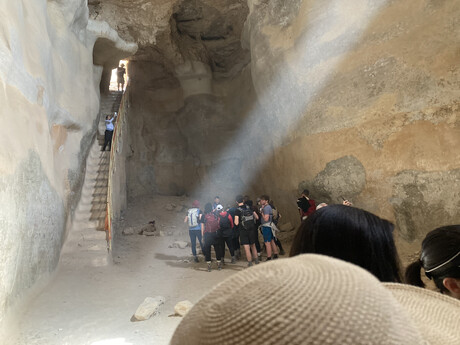
Petra, however, is far more than one iconic vista. A short walk past the Treasury reveals a trail — and serious hike — to the High Place of Sacrifice. Just beyond the trailhead is a large amphitheater, which sits opposite the Royal Tombs.
A short walk down the path and around a corner reveals Colonnaded Street — a street lined with Roman columns — the Great Temple and even a Byzantine-era Christian church.
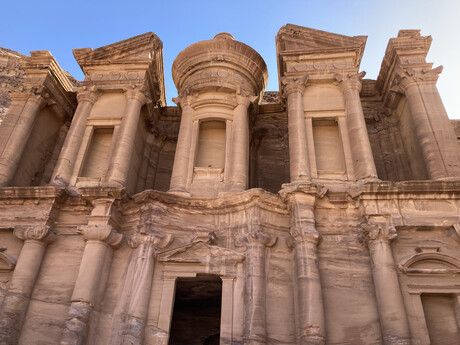
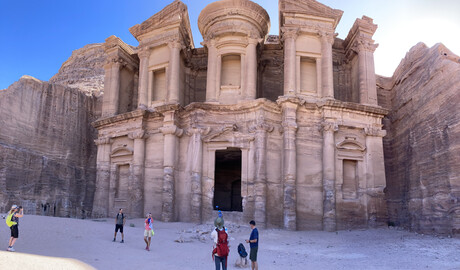
Further still, and a very serious hike later, is the Monastery. This mausoleum, also carved into sandstone, is much larger than the Treasury but less ornate. From the Monastery, a short walk reveals an overlook of Wadi Musa.
Petra is not a biblical city since there are no direct biblical references to it. However, it is biblically adjacent.
Petra is located next to Wadi Musa, which in Arabic means “Valley of Moses.” It's traditionally believed that Moses led the Israelites to this place and struck a rock that miraculously produced water. Additionally, the traditional burial site of Aaron, Moses’ brother, is located atop a hill visible from Petra. While the archaeological evidence of this assertion isn’t ironclad, it certainly makes for a good story.
Petra was the capital city of the Nabatean Kingdom — third century B.C. to 106 A.D. — which accumulated significant wealth as a trade center along major caravan routes.
In New Testament times, the Nabatean Kingdom was thriving. Aretas IV, the most powerful Nabatean king who reigned from 9 B.C. to 40 A.D., was a contemporary of Herod Antipas. Aretas gave his daughter to Herod in marriage, but the two had a falling out when Herod divorced Aretas’ daughter so he could marry Herodias, his brother's wife (see Matt. 14:1–2; Mark 6:14–29).
In Acts 9, Paul escapes from Damascus by being lowered in a basket from a window in the wall of the city. Paul comments on the experience in 2 Cor. 11:32 by saying, “The governor under King Aretas was guarding the city of Damascus in order to seize me." This must be Aretas IV, who ruled the Nabatean Kingdom from Petra, indicating the strength of the Nabateans.
The thing that made the Nabateans incredible was their genius-level ability to manage the scarce resource of water. The desert receives enough annual rainfall to sustain life, but it all falls in a short window of time. If there is no system in place to capture the water, it will run off and be lost.
At Petra, the Nabateans engineered a complex system to collect and store water during the annual rainy season. This system included many dams, hundreds of miles of channels, reservoirs and cisterns. At its peak, Petra’s water system made 12 million gallons of water available each day. The cumulative result of this system was an oasis in the desert.
Petra attracts nearly a million visitors annually. Most come to see the incredible architecture, carved directly into the sandstone. They come to see what is visible. What they can’t see is the even more incredible, but hidden, water system that made it all possible.
As I’ve been contemplating this article, I’ve come to see Petra as more than an incredible place to visit on vacation. Petra is an example for our own spiritual lives.
The world we live in is a spiritual desert. My message in this article is nearly the same as in my previous article for the July/August 2026 Gleaner, and that’s that we need a system in place to capture the living water. That system is our devotional lives.
When we think of our devotional lives, most of us immediately think of daily Bible reading and prayer. These are excellent things, but without some kind of plan, they can easily become routine.
Additional devotional ideas can include following a Bible reading plan, memorizing scripture, prayer journaling, praying with a prayer partner, joining a small group Bible study and reading spiritual books alongside the Bible.
I recently heard evangelism reports where dozens of people were baptized. Praise God! I’m certain, however, that this was the result of much prayer and Bible study on the part of the church members involved. They allowed themselves to become channels and reservoirs of living water.
A mentor of mine once told me that the only thing we have to offer of eternal value is the overflow of our time spent with God.
Our western obsession with success focuses primarily on results — the things that are visible. But we will not see the results we want in the church, and quite frankly in our own spiritual lives, until we learn to focus first and foremost on being filled with living water. Only then can we build an oasis in the desert.