



Whenever you do something new, you have to contend with the mystery of the unknown. Sometimes the discovery of that mystery comes with excitement, fear or a combination of several emotions. That’s what it was like for me the first time I went through Hezekiah’s Tunnel in Jerusalem.
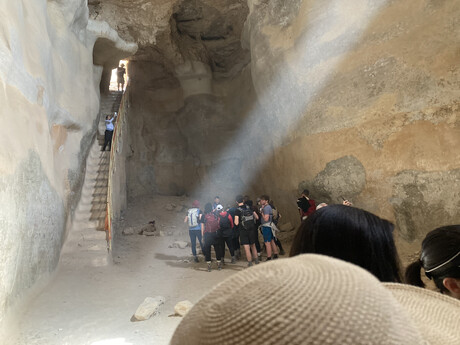
Our group knew that we were going to walk through the tunnel and that we’d get wet. But, as we descended the shockingly steep staircase single file through hewn rock, I couldn’t help but think that this might be an intense experience.
When we finally arrived at the entrance to the water portion of the tunnel, we prepared ourselves to get wet. I already had my swimwear underneath my pants. I stowed my pants and shoes in my backpack, got out my flashlight and went in.
Hezekiah’s Tunnel is a little wider than shoulder width and tall enough that you can almost always walk upright. The water gently flows just above your ankles as you walk, single file, through the length of the 1,750-foot tunnel. The only light is what you bring with you. I chose to go barefoot and noticed that the rock under my feet was smooth, presumably from the constantly flowing water and the innumerable multitudes who have walked that same path.
It's widely believed that the tunnel was constructed during the reign of Hezekiah, King of Judah, dating to the late 8th or early 7th century BC, as a channel for water. As the story goes, King Hezekiah had some advanced warning that Sennacherib, King of Assyria, planned to come and lay siege to Jerusalem (2 Chron. 32:1–5, 30).
In a siege, the attacking force surrounds a city, cutting it off from all supplies, in the hope of forcing it to capitulate. In this scenario, food and especially water supply became paramount.
In anticipation of the siege, King Hezekiah built the tunnel to divert the water of the Gihon Spring. Originally, the spring flowed out of the city walls to the Kidron Valley, where the attacking force would have had access to it. By diverting the water to the west, it remained inside the city walls, extending the supply of water to the inhabitants of Jerusalem and preventing the invaders from using it (2 Chron 32:30).
King Hezekiah understood that water is everything. No one can survive without water. By diverting the water, King Hezekiah gave himself and his city a significant strategic advantage during a very difficult time.
On one of my trips to the Holy Land, someone asked our guide why ancient civilizations always seemed to build on the same places. The answer was simple: access to water. It’s all about water.
In the Bible, water functions as more than just an essential for survival. Hezekiah’s Tunnel ends at the Pool of Siloam, which is mentioned in John 9. Jesus put mud on a blind man’s eyes and sent him to the pool to wash and receive sight for the first time. This is typical of what we find throughout the Bible: water used as a metaphor for salvation.
In John 9, the man born blind receives his sight by washing his face in the Pool of Siloam, which is fed by Hezekiah’s tunnel, which played a crucial role in saving Jerusalem from the Assyrian siege.
The book of John has numerous instances of the water/salvation metaphor. Jesus’ first miracle was turning water into wine (John 2:1–11). Jesus told Nicodemus that he must be born of water and the Spirit (John 3:5). Jesus offered the woman at the well living water (John 4:14). Jesus healed the crippled man who was hoping to be healed in the water at the Pool of Bethesda (John 5:1–17). Jesus washed His disciples’ feet (John 13:3–12). Finally, water and blood flowed out of Jesus’ side when the soldier pierced him after His death (John 19:34). In each of these references, the imagery of water points us to the realities of salvation.
Since several references to water in John also include the Spirit, it seems that the water/salvation metaphor means not only cleansing from sin, but also the new life we have by the power of the Holy Spirit (John 3:5; 7:37–38). Both are necessary in the plan of salvation.
God’s blessings and mercy — His salvation — are always available to us, but receiving them takes intentionality. Do you have a system in place to regularly collect the living water? Have you diverted the living water into a tunnel so that you will always have an abundant supply no matter what happens in life? My encouragement to you is to consider the habits of your life and ask yourself if those habits are collecting the living water or letting it flow on by.