



Greg Dodds, professor of history and chair of the Walla Walla University Department of History and Philosophy, gave the Roland Bainton Plenary Lecture at the 2018 annual meeting of the Sixteenth Century Society and Conference, which met in Albuquerque, N.M., in November. The conference, which just celebrated its 50th year, is a major international conference focusing on the early modern era — circa 1450 to 1660 — and covers a broad area of interdisciplinary studies.
“It was a significant honor, but also rather intimidating, to be asked to give the plenary address at a conference attended by hundreds of scholars from all over the world. Fortunately, it was well-received, and I was pleased to be able to represent Walla Walla University,” says Dodds.
In his lecture, “The Last Erasmians: Contesting the Public Memory of the Reformation in Restoration England,” Dodds explored how, 150 years after the Protestant Reformation, English Protestants were engaged in a heated debate about the nature of that Reformation. He explored how England was struggling with questions: Was the English Church the offspring of Erasmus or of Luther and Calvin? Should Protestants tolerate Catholics in England? How much unity was necessary in a church? Should England tolerate Quakers, Baptists and other dissenters? Dodds explains these were the questions that dominated public debate in an era characterized by the first newspapers, the first coffee houses and the first two political parties: the Whigs and the Tories.
“The central factor was the struggle to shape the public memory of the Reformation in order to control the future of the English nation,” says Dodds. As he said near the end of his lecture, “The world they created is, it would seem, our world: party politics, propaganda, ideological news and the battles for public memory.” By examining the works of English political writers Henry Care and Roger L’Estrange — the authors of the first two rival political newspapers — Dodds’ lecture explored how a society’s memory of the past, whether accurate or false, shapes how that society interprets and responds to current issues.
Dodds’ other areas of research include the life and reception of Desiderius Erasmus, the history of Christianity, religious toleration in Restoration England, post-Reformation England and the scientific revolution.
Learn more about the faculty in the WWU Department of History and Philosophy and their areas of interest and research at www.wallawalla.edu/history.
Charles Riseley, WWU university relations student writer

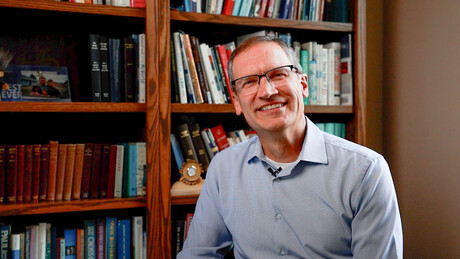
Greg Dodds, Walla Walla University history department professor and chair.